

A compact electric bike can offer a useful middle ground between a traditional bicycle and a large, heavy full-size e-bike. For younger riders—especially teens—the right compact model can feel easier to manage while still providing enough capability for neighborhood rides, recreation, commuting, or light off-road adventures.

A smaller frame doesn't automatically make an e-bike suitable for every young rider. Parents should consider the rider's height, inseam, strength, experience, coordination, and local age restrictions before making a purchase. A bike that feels manageable to a 16-year-old experienced rider may be inappropriate for a much younger or inexperienced child.
When properly matched to the rider, however, compact electric bikes can provide several advantages. They can be easier to maneuver, simpler to transport, more comfortable for shorter riders, and less intimidating than oversized electric bikes.
That combination is especially useful for teenagers who are transitioning from ordinary bicycles to more capable electric models.
What Makes an Electric Bike “Compact”?
There isn't one universal measurement that defines a compact electric bike.
Instead, the term generally describes an e-bike with a relatively short overall footprint, smaller wheels or tires, a more compact frame, and proportions that make the bike easier to handle than a traditional full-size model.
Common characteristics include:
- Smaller wheel diameters
- Shorter wheelbases
- Lower or more accessible frames
- Compact handlebars
- Reduced overall length
- Fat tires on some models
- A riding position designed for maneuverability
- Easier storage and transportation
Compact doesn't necessarily mean weak.
Some compact electric bikes use powerful motors and large-capacity batteries. That's why parents shouldn't judge a bike based on physical size alone. Motor output, top speed, weight, braking performance, and intended riding environment are equally important.
Why Size Matters for Younger Riders
One of the most important principles when choosing any bicycle is proper fit.
NHTSA recommends riding a bike that fits the rider because an oversized bicycle can be harder to control.
This becomes even more important with an electric bike because the motor can increase acceleration and overall speed.
A properly sized compact bike allows a rider to:
- Reach the handlebars comfortably
- Operate the brakes without stretching
- Keep a stable riding position
- Turn with greater confidence
- Put a foot down when necessary
- Control the bike at lower speeds
- Handle stops and starts more naturally
In other words, compact design isn't just about convenience. It can directly affect how confidently a younger rider interacts with the bike.
7 Powerful Benefits of Compact Electric Bikes
1. Easier Handling and Better Control
The first major advantage is maneuverability.
A compact electric bike generally takes up less physical space and can feel more responsive during turns. For younger riders who haven't developed the strength or experience needed to control a large e-bike, this can make a noticeable difference.
A shorter wheelbase can also make the bike feel more agile. Riders may find it easier to navigate narrow paths, make controlled turns, and position the bike when stopping.
This doesn't mean a compact bike is automatically safer. Rather, proper fit can make the controls easier to manage, which is an important part of responsible riding.
Parents should let the rider practice first in a controlled environment. An empty paved area, private property where permitted, or another appropriate low-traffic location can provide space to learn acceleration, braking, turning, and stopping.
The goal isn't to teach a rider to go fast.
It's to teach them to stay in control.
2. A More Comfortable Riding Position
Younger riders often have shorter arms and legs than adults.
A full-size adult e-bike may force them to reach too far forward or sit in an awkward position. Even if they technically can reach the controls, the bike may not feel natural.
A compact electric bike can solve part of this problem by bringing the controls and riding position closer to the rider.
Comfort matters because uncomfortable riders tend to change position frequently, grip the handlebars too tightly, or struggle to maintain a balanced posture.
A comfortable riding position should allow the rider to:
- Keep their elbows slightly relaxed
- Reach both brake levers easily
- Maintain a balanced posture
- Look ahead rather than down
- Turn without excessive body movement
- Mount and dismount confidently
For longer rides, these small details can make a big difference.
3. Lightweight Design Makes Everyday Riding Easier
Electric bikes are often heavier than traditional bicycles because of their motors, batteries, wiring, and reinforced frames.
That's one reason compact design can be useful.
A smaller electric bike may be easier to move around a garage, position in a storage area, load onto suitable transportation equipment, or maneuver when the motor isn't being used.
This is especially helpful for younger riders who don't have the physical strength of an adult.
However, don't assume that every compact e-bike is lightweight. Some fat-tire electric bikes can still be substantial machines.
Before buying, check the actual bike weight and compare it with the rider's ability to move the bike safely.
A simple test is worth considering: Can the rider safely turn the bike around, walk it backward, park it, and lift the front or rear end when necessary?
If the answer is no, the bike may be too large or heavy for that rider.
4. Fat Tires Can Improve Confidence on Mixed Terrain
Many compact electric bikes use wide tires.
Fat tires can provide a broader contact patch with the ground and may help riders feel more stable on surfaces such as packed dirt, gravel, grass, and uneven paths.
For younger riders interested in outdoor riding, this can be a major attraction.
A wider tire can also contribute to a more planted feeling when riding over minor bumps. Still, tire width doesn't eliminate the need for caution. Wet surfaces, loose gravel, steep slopes, potholes, and obstacles can all affect handling.
Riders should learn how the bike behaves before attempting challenging terrain.
The VICTRIP R6, for example, uses 16-inch x 4-inch fat tires and is positioned as a compact off-road-style e-bike for teens and adults.
That combination makes it an interesting option for riders who want a smaller footprint without giving up the stability and versatility associated with fat tires.
5. Electric Assistance Makes Longer Rides More Enjoyable
Electric assistance is another major reason younger riders may enjoy compact e-bikes.
On a traditional bicycle, hills and long distances can quickly become tiring. Electric assistance can help reduce some of that physical effort, allowing riders to travel farther without feeling completely exhausted.
That can make recreational riding more appealing.
For example, a teenager might use an e-bike for:
- Neighborhood exploration
- Park rides
- Weekend recreation
- School-area transportation where legal
- Light trails
- Family cycling trips
- Short local errands with parental approval
The important thing is to use assistance responsibly.
More motor power isn't automatically better for a younger rider. A powerful motor can increase acceleration and speed, so the rider must have enough experience and judgment to control it.
6. Compact Bikes Can Grow With a Teen Rider
Teenagers grow quickly.
A bicycle that fits perfectly one year may feel too small later. That's why adjustability and rider fit should be considered before purchase.
Look for features such as:
- Adjustable seat height
- Comfortable handlebar position
- Multiple assistance levels
- Suitable weight capacity
- A frame size that leaves room for growth
- Easy-to-use controls
A compact electric bike may also become useful beyond recreational riding.
As a teenager becomes more experienced, the same bike may be used for longer neighborhood rides, commuting where permitted, or more advanced recreational riding.
That's a better value proposition than buying a bike that only works for a short period.
7. They Make Outdoor Riding More Appealing
Let's face it: teenagers aren't always excited about traditional exercise.
An electric bike can make outdoor activity feel more like an adventure than a workout.
Compact models are especially appealing because they often have a sporty appearance and are easier to maneuver.
A rider may be more motivated to explore a local trail, meet friends, or spend a weekend outdoors when the transportation itself is part of the fun.
That can turn cycling into a regular hobby rather than something a parent has to encourage every weekend.

What to Look for Before Buying
Choosing a compact electric bike requires more than looking at the price tag.
Parents should evaluate the complete package.
| Feature | Why It Matters |
| Frame size | Determines overall fit |
| Bike weight | Affects handling and storage |
| Motor output | Influences acceleration and hill performance |
| Speed settings | Helps match power to rider experience |
| Battery capacity | Determines potential riding distance |
| Brakes | Essential for controlled stopping |
| Tire size | Influences stability and terrain capability |
| Suspension | Can improve comfort on uneven surfaces |
| Weight capacity | Must accommodate the rider safely |
| Controls | Should be easy to understand |
| Lighting | Helps improve visibility |
| Local legality | Determines where and how the bike can be used |
Motor Power and Speed
Motor power deserves special attention.
A common mistake is assuming that a higher-wattage motor automatically makes a bike better.
For younger riders, controllability should come before maximum performance.
A bike with multiple assistance levels can be useful because the rider can begin with lower settings and gradually become more comfortable.
Battery Range and Charging
Battery capacity is another important consideration.
A larger battery can potentially support longer rides, but actual range depends on many factors, including:
- Rider weight
- Terrain
- Speed
- Temperature
- Tire pressure
- Assistance level
- Wind
- Riding style
The R6 lists a 48V 15Ah LG battery and a claimed range of up to 60 miles under stated conditions.
Parents shouldn't assume the maximum advertised range will always be achieved.
Instead, think about the rider's normal trip.
If most rides are five to ten miles, there's little reason to choose a model solely because it advertises an extremely long theoretical range.
Brakes, Tires, Suspension, and Frame Design
Performance components matter because they influence how the bike behaves.
Brakes
A younger rider needs brakes that are easy to operate and capable of bringing the bike to a controlled stop.
Parents should check:
- Brake type
- Lever reach
- Brake condition
- Rotor condition
- Pad wear
- Stopping response
Teach the rider to use both brakes appropriately rather than relying only on one.
Tires
Tire pressure should be checked regularly.
Underinflated tires can increase rolling resistance and affect handling, while excessive pressure may reduce comfort and traction on certain surfaces.
Always follow the manufacturer's recommended pressure range.
Suspension
Suspension can improve comfort on uneven terrain, but it shouldn't be treated as a substitute for good riding technique.
A rider should still slow down before bumps, avoid obstacles they can't safely navigate, and keep both hands on the handlebars.
Frame Design
The frame should feel stable rather than awkward.
When seated, the rider should be able to maintain a natural posture and reach the controls without excessive stretching.
VICTRIP R6: A Compact Option for Teens
For families specifically looking for a compact electric bike with off-road styling, the VICTRIP R6 Off Road Ebike is worth considering.
The R6 is marketed as a 16-inch x 4-inch fat-tire, moped-style electric bike for teens and adults. Its compact proportions distinguish it from many conventional full-size e-bikes.
It's the combination of compact dimensions, fat tires, electric assistance, and an off-road-oriented design.
For an appropriately sized and experienced teen, that combination can provide a more approachable alternative to a much larger e-bike.
However, parents should pay attention to the R6's performance specifications. A 28-mph-capable electric bike isn't appropriate for every young rider, and it shouldn't be treated like a children's bicycle. Age requirements, helmet requirements, speed restrictions, road access, and e-bike classification vary by location.
The best approach is to match the bike to the rider rather than expecting the rider to adapt to an overly powerful machine.
TOP PICK
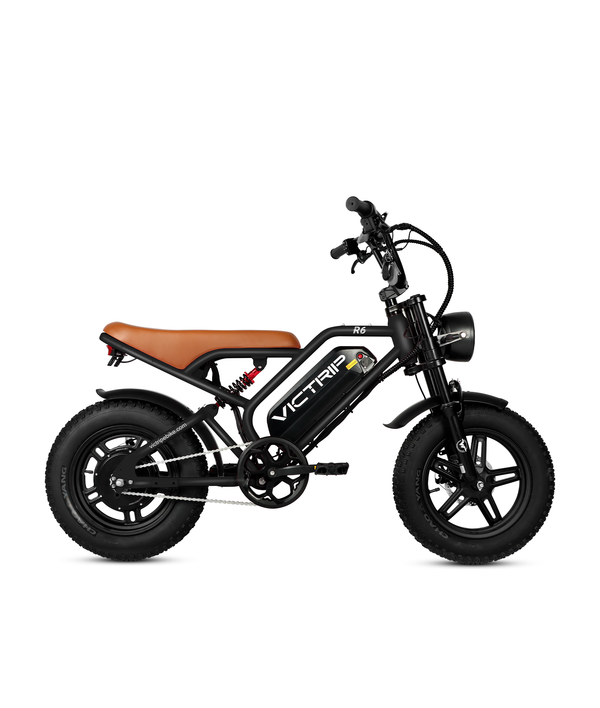
VICTRIP®R6 Moped Ebike for Teens
$799.00
How to Introduce a Younger Rider to an E-Bike
Don't make the first ride a long-distance adventure.
Start small.
Step 1: Learn the Controls
Before moving, the rider should understand:
- Power button
- Assistance controls
- Brake levers
- Display
- Gears
- Lighting controls
- Throttle, if equipped
They should know how to turn the motor off quickly.
Step 2: Practice Without Traffic
Begin somewhere flat and controlled.
Practice:
- Starting
- Stopping
- Slow-speed balance
- Gentle turns
- Emergency braking
- Looking over the shoulder
- Walking the bike
- Parking
Don't rush.
Step 3: Introduce Assistance Gradually
Start at the lowest practical assistance setting.
Once the rider understands how acceleration feels, higher settings can be introduced when appropriate.
Step 4: Practice Braking
Braking deserves extra attention.
The rider should learn to slow down before corners and obstacles instead of braking aggressively in the middle of a turn.
Step 5: Increase Distance Slowly
Once the rider demonstrates reliable control, gradually increase ride length and terrain difficulty.
This approach builds confidence without overwhelming the rider.
Safety Tips Parents Should Follow
Safety should always come before performance.
NHTSA recommends properly fitting helmets, using visible equipment, riding a bike that fits, and ensuring that the bicycle works correctly before riding.
A useful safety checklist includes:
- Wear a properly fitted helmet every ride.
- Use appropriate protective equipment for the terrain.
- Check brakes before riding.
- Check tire pressure.
- Make sure the battery is secure.
- Use lights and reflectors when visibility is poor.
- Avoid riding beyond the rider's skill level.
- Don't carry passengers unless the bike is specifically designed and legally permitted for that purpose.
- Keep both hands on the handlebars except when signaling.
- Follow local traffic and e-bike regulations.
- Avoid distracted riding.
- Never ride under the influence of alcohol or drugs.
Parents should also inspect the helmet itself. The U.S. Consumer Product Safety Commission maintains bicycle-helmet recall information, which is useful for checking whether a helmet has been recalled.
Where Can Younger Riders Safely Ride?
This depends heavily on location.
Some areas permit certain classes of e-bikes on bicycle paths and roads, while others have age, speed, equipment, or licensing requirements.
A bike that is legal on private property may not be legal on public roads.
Parents should check:
- Local e-bike classification rules
- Minimum rider age
- Helmet requirements
- Speed restrictions
- Trail rules
- Road access
- Equipment requirements
- Whether throttle use is permitted
- Whether registration is required
Don't rely solely on advice from a friend or an online forum.
Regulations can change, and the rules in one state, province, city, or country may be completely different from those somewhere else.
Compact Electric Bikes vs. Full-Size E-Bikes
How does a compact electric bike compare with a traditional full-size model?
| Category | Compact Electric Bike | Full-Size E-Bike |
| Maneuverability | Usually easier | Can feel larger |
| Storage | Generally easier | Requires more space |
| Transport | Often more convenient | Can be harder to transport |
| Shorter riders | Often better suited | May feel oversized |
| Stability | Depends on tire/frame design | Often very stable |
| Long-distance riding | Model dependent | Often well suited |
| Off-road use | Model dependent | Broad range available |
| Teen appeal | Often high | Varies |
| Growth potential | Depends on frame | Often better for adults |
| Weight | Varies significantly | Often heavier |
The important point is that compact doesn't mean universally better.
A tall teenager who frequently rides long distances may prefer a larger frame. A shorter teenager who wants something maneuverable may appreciate a compact design much more.
Fit should always win the argument.
Conclusion: Choose Control, Comfort, and Confidence
A compact electric bike can be an excellent choice for the right younger rider because it combines manageable dimensions with the convenience and excitement of electric assistance.
The biggest advantages include easier handling, a more comfortable riding position, simpler storage, fat-tire stability on suitable terrain, and an engaging way to spend more time outdoors.
But parents shouldn't focus only on appearance or motor specifications.
The best compact electric bike is one that fits the rider, matches their experience, provides controllable performance, and can be used legally in the intended riding environment.
For teens looking for a compact, fat-tire option with more serious electric-bike capability, the VICTRIP R6 is one model worth evaluating. Its 16 x 4-inch tires and compact moped-style design make it particularly interesting for riders who want a balance between maneuverability and off-road versatility.
At the end of the day, the smartest choice isn't necessarily the fastest bike.
It's the bike the rider can control confidently, ride responsibly, and enjoy for years to come.
FAQs
Are compact electric bikes good for teenagers?
They can be, provided the bike is appropriately sized, the rider is physically and mentally capable of controlling it, and its use complies with local regulations. Compact dimensions can make certain models easier for shorter riders to manage.
What age is appropriate for a compact electric bike?
There isn't one universal age that applies to every e-bike. Minimum ages and legal requirements vary by location and bike classification. Parents should check local rules and the manufacturer's recommendations before purchase.
Is a compact electric bike safer than a full-size e-bike?
Not automatically. A correctly sized bike may be easier to control, but safety also depends on speed, braking, rider experience, terrain, protective equipment, and responsible riding.
How far can a compact electric bike travel?
Range depends on the battery, rider weight, terrain, speed, weather, tire pressure, and assistance level. Manufacturer range figures should be treated as estimates rather than guaranteed real-world distances.

Share:
How Often Does Your Child Need to Ride for an Electric Dirt Bike to Be Worth It?
Best Electric Mini Dirt Bike for Young Riders: What to Look For