


1. Riding Is More Than Just Fun
When parents hear the words electric dirt bike for kids, the first things that often come to mind are excitement, outdoor play, and adventure. However, riding can offer much more than entertainment when it's introduced at the right age and practiced in a controlled environment.
A properly selected electric dirt bike can give children an opportunity to develop practical skills while they're having fun. They can learn how to balance, control their movements, follow instructions, make decisions, and understand the consequences of their actions.
Of course, an electric dirt bike isn't a replacement for school, sports, or other childhood activities. Instead, it can become another useful way for children to learn through hands-on experience.
The key is how the activity is introduced.
A child who simply jumps on a bike and rides as fast as possible may learn very little beyond basic throttle control. On the other hand, a child who learns to inspect the bike, wear protective equipment, follow riding rules, control speed, and practice gradually can develop valuable habits that extend beyond riding.
That's what makes this activity especially interesting for parents.
A Different Kind of Learning
Children often learn best when they're actively involved in something. Riding creates immediate feedback.
If a child turns too sharply, they can feel the difference. If they brake too hard, they can understand why smooth control matters. If they approach a small obstacle incorrectly, they can try again with a better technique.
This hands-on process can make abstract ideas easier to understand.
For example:
- Responsibility becomes checking the bike before riding.
- Patience becomes practicing a difficult turn repeatedly.
- Self-control becomes keeping the speed within a safe limit.
- Problem-solving becomes figuring out how to approach uneven terrain.
- Confidence comes from mastering a skill that once felt difficult.
These lessons can gradually become part of a child's everyday behavior.
2. Learning Balance and Coordination
One of the first physical skills children can develop through riding is balance.
An electric dirt bike requires riders to coordinate several movements at the same time. They need to maintain their body position, steer the handlebars, control the throttle, operate the brakes, and watch the terrain ahead.
At first, that may feel like a lot.
With practice, however, these movements can become more natural.
How Balance Develops
Balance isn't simply about staying upright. Children also learn how their body position affects the bike.
For example, when moving slowly, a rider may need to make small steering corrections. When approaching uneven ground, they may learn to keep their body relaxed rather than becoming stiff.
These experiences help children understand body control.
The learning process can be gradual:
- Start on a flat, open surface.
- Practice moving slowly.
- Learn smooth starts and stops.
- Practice gentle turns.
- Introduce simple changes in terrain.
- Gradually increase riding complexity as skills improve.
This approach gives children time to develop control instead of expecting them to master everything in one afternoon.
Why Coordination Matters
Coordination is useful far beyond dirt-bike riding.
Children use coordination when playing sports, climbing, swimming, riding bicycles, and participating in many other physical activities. Riding can give them another opportunity to practice connecting what they see with how their body responds.
For younger riders, simple exercises can make practice more engaging.
Parents might create a basic course using safe markers and ask the child to ride slowly between them. The goal isn't speed. The goal is controlled movement.
That's an important distinction.
3. Building Confidence Through Practice
Confidence is another valuable lesson children can gain from riding.
However, healthy confidence doesn't come from having the fastest bike or riding faster than someone else. It comes from developing a skill and realizing, “I couldn't do this before, but now I can.”
Small Wins Create Confidence
A child might initially struggle with:
- Starting smoothly
- Stopping at a specific point
- Making a controlled turn
- Riding over a small change in terrain
- Maintaining a steady speed
- Following a practice route
Once they improve, they get a clear sense of achievement.
Parents can reinforce this by praising effort and progress rather than speed.
Instead of saying:
“You're really fast!”
Try focusing on the process:
“You controlled that turn much better this time.”
That kind of feedback teaches children that improvement comes from practice.
Learning From Mistakes
Mistakes are part of learning.
A child may take a turn too wide, stop too quickly, or become nervous when encountering an unfamiliar surface. These moments can become learning opportunities when handled calmly.
Parents should avoid turning every mistake into criticism.
Instead, ask questions such as:
- What happened?
- What did you notice?
- What could you try differently?
- Did you feel comfortable with that speed?
- Should we practice it again more slowly?
This encourages children to think about their actions instead of simply waiting for adults to tell them what they did wrong.
Over time, this can help develop a growth mindset.
4. Developing Responsibility
An electric dirt bike isn't a toy that should simply be picked up and used without preparation.
Children can learn responsibility by becoming involved in the basic care and preparation of their bike.
Pre-Ride Responsibilities
Before every ride, parents can establish a simple checklist.
| Check | What Kids Can Learn |
| Helmet | Personal safety |
| Brakes | Equipment awareness |
| Tires | Basic inspection |
| Battery | Understanding preparation |
| Throttle | Mechanical awareness |
| Riding area | Environmental awareness |
| Protective gear | Personal responsibility |
Younger children may need parents to perform the actual inspection, but they can still participate.
For example, a parent can ask, “What should we check before we ride?”
Eventually, the child may begin answering without being prompted.
That small change represents meaningful progress.
Taking Care of the Bike
Children can also learn that equipment needs care.
After riding, they can help:
- Put the bike away properly
- Clean dirt from appropriate areas
- Store protective gear
- Connect the charger with adult supervision when appropriate
- Report unusual sounds or problems
- Keep the riding area organized
These habits teach a simple but important principle: things work better when they're properly maintained.
That's a lesson that can apply to bicycles, sports equipment, school supplies, and countless other possessions.
5. Improving Focus and Concentration
Riding requires attention.
A child needs to look ahead, notice changes in the ground, control the bike, and respond to instructions. This can encourage active concentration rather than passive entertainment.
Staying Aware While Riding
Parents can teach children to scan the riding environment.
Before entering an area, ask:
- Where are the obstacles?
- Where are the boundaries?
- Is anyone else riding nearby?
- Is the surface smooth or uneven?
- Where should you stop?
These questions help children develop situational awareness.
The skill isn't about making children nervous. It's about teaching them to notice what's happening around them.
Understanding Distractions
Children can also learn why distractions matter.
Talking to friends, looking behind them, using a phone, or focusing too much on another rider can reduce attention.
A simple rule works well:
When the bike is moving, focus on riding.
This principle is useful in many areas of life, from sports to crossing roads to completing schoolwork.
6. Learning Patience and Self-Control
One of the most important lessons a child can learn from riding is that faster isn't always better.
Electric dirt bikes can feel exciting because electric motors deliver power quickly. That excitement can make children want to go faster before they've developed enough control.
This is where parents can turn riding into a lesson about self-control.

Why Speed Isn't Everything
A skilled rider isn't simply someone who travels quickly.
A skilled rider understands how to:
- Control acceleration
- Brake smoothly
- Maintain balance
- Choose an appropriate speed
- React to changing terrain
- Stop when necessary
In other words, control matters more than speed.
Parents can make slow riding into a challenge. For example, ask the child to complete a short course without touching the boundary markers.
This can be surprisingly fun.
It also teaches precision.
Learning to Follow Limits
Speed limits, riding boundaries, and parental rules may initially seem restrictive to children.
But these rules can teach an important concept: freedom works best when it's combined with responsibility.
A child who learns to respect riding limits is practicing self-control.
That lesson can transfer to other situations, such as:
- Following sports rules
- Waiting their turn
- Managing screen time
- Completing homework before playing
- Listening to instructions
Riding can therefore become a practical way to discuss why rules exist.
7. Developing Problem-Solving Skills
Riding can present small challenges that require children to think rather than simply react.
For example, a child may encounter a patch of grass, loose dirt, a gentle slope, or a narrow section of a practice area.
Instead of immediately telling them what to do, parents can sometimes ask what they think would be safest.
Handling Simple Riding Challenges
Suppose a child approaches an unfamiliar section of terrain.
A parent might ask:
“What do you notice?”
Then:
“How could you approach it more slowly?”
This encourages the child to observe and make a decision.
Parents should always step in when safety requires it, but allowing children to think through low-risk situations can build independence.
Learning From the Terrain
Different surfaces behave differently.
A child can gradually learn that grass, packed dirt, loose gravel, and wet surfaces may require different riding techniques.
This doesn't mean children should be exposed to difficult terrain simply for the sake of learning.
Instead, parents can introduce simple, age-appropriate conditions gradually.
The important lesson is that the environment affects the way you should act.
That's a useful real-world skill.
8. Understanding Safety and Risk Awareness
Safety education should be at the center of children's riding.
An electric dirt bike can be enjoyable, but children need to understand that motorized riding requires attention and protective equipment.
The U.S. Consumer Product Safety Commission emphasizes the importance of properly fitted helmets for bike and e-bike riders. Its current guidance also highlights that helmets are intended to reduce the risk of serious head injuries.
Parents can read the CPSC's bicycle helmet guidance for additional safety information: CPSC Bicycle Helmet Safety Guidance
Learning to Evaluate a Riding Area
Before a child rides, parents should assess the environment.
Look for:
- Traffic
- Steep drops
- Deep water
- Large obstacles
- Sharp objects
- Other riders
- Pedestrians
- Areas where visibility is poor
A child doesn't need to memorize a complicated safety manual.
Instead, teach a few repeatable habits.
Stop. Look. Think. Then ride.
Over time, children can begin applying the same thinking independently.
Protective Gear and Safe Habits
A suitable helmet is essential, and additional protective equipment may be appropriate depending on the riding environment and vehicle.
Parents should also check that protective gear fits correctly.
The American Academy of Pediatrics notes that children should wear an appropriate helmet every time they ride, and that an improperly fitting helmet may not provide adequate protection.
This is one area where parents should avoid shortcuts.
A child might complain that safety gear isn't comfortable. That's understandable. But safety habits should be established before riding becomes routine.
9. Encouraging Outdoor Activity
Today's children have plenty of indoor entertainment available.
An electric dirt bike can provide another reason to get outside.
Outdoor riding can encourage children to move their bodies, explore their surroundings, and spend time away from screens.
It can also create variety.
Instead of spending every afternoon doing the same activity, a child might spend one day riding, another day playing soccer, and another day cycling with family.
The goal shouldn't be to make riding the only activity.
Rather, it can become one part of an active lifestyle.
Parents can make outdoor time even more enjoyable by creating small challenges or riding sessions.
For example:
- Practice controlled turns
- Set up a simple obstacle course
- Work on stopping accuracy
- Explore a safe private riding area
- Practice riding at different controlled speeds
These activities make practice feel more like a game.
And let's be honest: kids usually learn better when they're having fun.
10. Learning Independence While Following Rules
Children naturally want more independence as they grow.
Riding can provide a controlled opportunity to practice it.
A parent might gradually allow a child to take responsibility for certain tasks:
Stage 1: Parent handles preparation and supervision.
Stage 2: Child helps with preparation.
Stage 3: Child explains the safety checklist.
Stage 4: Child demonstrates proper riding behavior.
Stage 5: Parent continues supervision while giving the child more decision-making responsibility.
The exact progression depends on the child's age, maturity, riding experience, and the vehicle being used.
The important point is that independence shouldn't mean removing supervision.
Instead, it should mean gradually increasing responsibility.
This teaches children that greater freedom comes with greater accountability.
11. Social Skills and Family Bonding
Riding doesn't have to be a solo activity.
Parents can use riding time as an opportunity to spend quality time with their children.

A parent might watch a practice session, help set up a safe course, discuss riding techniques, or simply celebrate progress.
Children can also develop social skills when riding with siblings or friends in an appropriate supervised environment.
They can learn:
- Taking turns
- Respecting boundaries
- Communicating clearly
- Encouraging others
- Following shared rules
- Avoiding reckless competition
Parents should be careful with racing.
Competitive riding can sometimes encourage children to take unnecessary risks. A better approach for younger riders is to emphasize skill challenges rather than winning.
For example, instead of asking, “Who can go fastest?” try:
“Who can complete the course with the best control?”
That changes the entire experience.
12. Choosing an Electric Dirt Bike That Supports Learning
The right electric dirt bike for kids should match the child's age, size, experience, and ability.
Parents shouldn't choose a model based solely on maximum speed or motor power.
A powerful bike can be difficult for an inexperienced rider to control.
Age and Rider Size
Start with the manufacturer's recommended rider information.
Consider:
- Seat height
- Rider weight
- Overall bike weight
- Riding position
- Reach to controls
- Intended skill level
An oversized bike can make learning unnecessarily difficult.
The American Academy of Pediatrics also warns against buying children oversized bikes to “grow into,” because a bike that's too large can be harder for a child to control.
Speed Control
Adjustable speed settings can be particularly useful for young or inexperienced riders. A beginner can start at a lower setting while learning basic controls. As their skills improve, parents can decide whether a higher setting is appropriate.
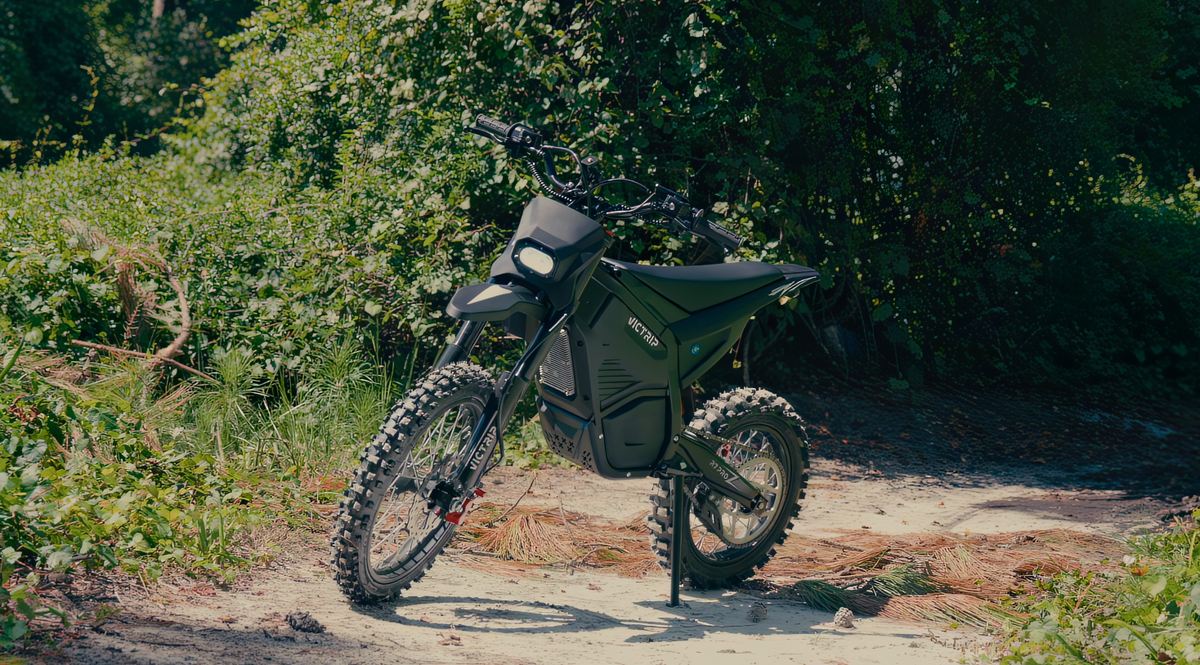
For families looking for a kid-focused option, the VICTRIP X9 Electric Dirt Bike for Kids is worth considering. It's designed around the needs of younger riders, making it a practical choice for children who are learning the basics of electric dirt-bike riding. Features such as manageable controls and a kid-friendly design can help children focus on developing balance, steering, braking, and riding confidence rather than simply chasing higher speeds.
This creates a natural progression:
Learn → Practice → Improve → Increase responsibility
Rather than:
Buy → Accelerate → Hope for the best
That difference matters.
Brakes and Tires
Reliable braking is essential.
Parents should make sure the child understands how the brakes work before riding independently.
Tires should also be appropriate for the intended riding surface.
Different tread patterns can perform differently on dirt, grass, gravel, and other surfaces.
Suspension and Stability
For off-road riding, suspension can help the bike handle changes in terrain more comfortably.
However, suspension doesn't eliminate the need for good riding technique.
Children still need to learn:
- Proper body positioning
- Controlled speed
- Smooth braking
- Awareness of obstacles
- Appropriate route selection
The bike can support the learning process, but it can't replace it.
13. How Parents Can Turn Riding Into a Learning Experience
Parents don't need to become professional riding instructors to make the activity educational.
A few simple habits can make a major difference.
Create a Pre-Ride Routine
Before every ride, ask the child to check:
- Helmet
- Protective equipment
- Bike condition
- Battery level
- Brakes
- Riding area
- Riding rules
Eventually, the routine can become automatic.
Set One Skill Goal
Instead of trying to teach everything during one session, choose one goal.
For example:
Today's goal: smooth braking.
Next time:
Today's goal: controlled turns.
Then:
Today's goal: maintaining a steady speed.
This keeps practice manageable.
Ask Questions
Questions encourage children to think.
Try asking:
- “What did you notice?”
- “Why did the bike feel different there?”
- “What could you do differently?”
- “Was that speed comfortable?”
- “Where should you stop?”
The goal isn't to quiz them.
It's to help them develop their own judgment.
Praise Good Decisions
Don't only praise successful riding.
Praise good decisions too.
If a child decides to slow down before an obstacle, that's worth recognizing.
If they stop because another person enters the riding area, that's responsible behavior.
If they admit they're uncomfortable with a section of terrain, that's also a good decision.
These moments teach children that being responsible is more important than looking fearless.
14. The 9 Key Skills Kids Can Learn From Riding
Here's a quick summary of the major lessons:
| Skill | How Riding Can Teach It |
| Balance | Maintaining body position |
| Coordination | Controlling multiple inputs |
| Confidence | Mastering new skills |
| Responsibility | Preparing and caring for the bike |
| Focus | Watching the environment |
| Patience | Practicing difficult skills |
| Self-control | Managing speed |
| Problem-solving | Responding to changing terrain |
| Risk awareness | Identifying hazards |
These skills aren't guaranteed simply because a child owns an electric dirt bike.
The learning comes from how the bike is used.
Supervised, structured riding can create far more educational value than unrestricted riding.
Frequently Asked Questions
Is an electric dirt bike good for kids?
An electric dirt bike can be a fun way for children to develop balance, coordination, focus, responsibility, and confidence when the bike is age-appropriate and used in a safe, supervised environment.
Parents should consider the child's maturity, physical size, riding experience, and the manufacturer's recommendations before choosing a model.
What can children learn from riding an electric dirt bike?
Children can learn physical skills such as balance and coordination, as well as life skills such as patience, responsibility, concentration, self-control, decision-making, and risk awareness.
The educational benefits depend heavily on parental supervision and how riding sessions are structured.
Should kids start with a fast electric dirt bike?
Generally, beginners benefit from learning on a bike that they can comfortably control rather than choosing a model based on maximum speed.
Adjustable speed settings can be useful because they allow children to develop basic riding skills before moving to higher speeds.
What safety gear should kids wear?
At minimum, children should use a properly fitted helmet appropriate for the type of riding they're doing. Depending on the riding environment and vehicle, parents may also choose protective gloves, eye protection, suitable footwear, knee protection, elbow protection, and other protective equipment.
Always follow the safety recommendations provided by the bike manufacturer and applicable local rules.
Can riding help a shy child become more confident?
It can help some children build confidence because riding provides clear, measurable progress.
A child may initially struggle with a simple turn but eventually master it through practice. That experience can reinforce the idea that effort and patience lead to improvement.
However, parents shouldn't pressure a reluctant child to ride.
Conclusion
An electric dirt bike for kids can be much more than a source of weekend entertainment.
When parents choose an age-appropriate model and create a safe, structured riding environment, children can use riding as an opportunity to develop balance, coordination, concentration, confidence, patience, responsibility, problem-solving skills, and risk awareness.
The biggest lesson may be that progress takes practice.
Children don't need to become expert riders overnight. They can start with simple skills, make mistakes, learn from them, and gradually become more capable.
Parents can make the experience even more valuable by focusing on responsible decisions instead of speed. Encourage children to inspect their bike, wear the right protective equipment, understand their surroundings, follow riding boundaries, and respect their own limits.
In the end, the best riding experience isn't necessarily the fastest one.
It's the one where a child finishes the session feeling more confident, more responsible, and more capable than when they started.
Share:
Electric Dirt Bike Weight Guide: Does Weight Matter for Performance?
How Often Does Your Child Need to Ride for an Electric Dirt Bike to Be Worth It?