

Choosing an electric bike for a young rider isn't simply about finding a bike that looks exciting. Parents need to think about rider size, speed, braking, battery safety, riding environment, and local regulations. The right youth electric bike should match the rider's ability rather than simply offer the most power.

For families exploring top youth electric bikes for beginners, the first step is understanding what makes an e-bike appropriate for a younger rider. A smaller frame, manageable acceleration, predictable handling, and effective brakes can matter much more than a large motor or high top speed.
This guide explains the key features parents should know before buying, how to compare different types of youth e-bikes, and what to check before the first ride.
Quick Overview: What Parents Should Look For
| Feature | What to Check | Why It Matters |
|---|---|---|
| Rider fit | Seat height, reach, frame size | Helps the rider maintain control |
| Speed | Appropriate maximum speed | Makes learning easier |
| Motor response | Smooth acceleration | Reduces sudden surges |
| Brakes | Reliable hand brakes | Supports controlled stopping |
| Tires | Suitable width and tread | Improves traction |
| Battery | Quality battery and charger | Important for electrical safety |
| Controls | Simple display and controls | Easier for beginners to learn |
| Weight | Manageable overall weight | Helps with handling and parking |
| Safety equipment | Helmet, lights, reflectors | Improves rider protection and visibility |
| Local rules | Age, speed, class, and riding-area rules | Requirements vary by location |
Why Choosing the Right Youth Electric Bike Matters
Electric bikes can make riding more accessible and enjoyable. A motor can help a rider handle hills and longer distances without the same physical effort required on a conventional bicycle.
However, electric assistance also changes the riding experience. A bike that accelerates quickly or reaches a high speed can require more skill to control.
That's why parents shouldn't judge a bike only by motor wattage, battery capacity, or advertised speed.
A beginner needs a bike that feels predictable.
The rider should be able to:
- Start smoothly.
- Reach the controls comfortably.
- Brake without excessive effort.
- Turn without struggling with the bike's weight.
- Keep both hands firmly on the handlebars.
- Understand how the motor responds.
- Stop confidently before riding in more complicated environments.
The Consumer Product Safety Commission recommends that riders follow local traffic laws, wear a bicycle helmet, inspect the bike before riding, and follow the manufacturer's age and weight limits.
For parents, that means the buying process shouldn't stop when the payment is completed. Choosing the right equipment and teaching good riding habits are equally important.
1. Start With Rider Size, Not Motor Power
One of the most common mistakes is shopping by motor specifications first.
A powerful motor might look impressive on a product page, but it doesn't automatically make a bike better for a young rider.
Fit should come first.
Check the Rider's Height
Measure the rider before shopping. Compare that measurement with the manufacturer's recommended rider range rather than relying only on a general age recommendation.
Two children of the same age can have very different heights and riding abilities.
A suitable bike should allow the rider to:
- Reach the handlebars naturally.
- Maintain a comfortable riding position.
- Operate the brakes without stretching.
- Keep stable control while turning.
- Put a foot down when needed.
- Mount and dismount without difficulty.
Consider Weight Too
Weight matters because young riders may need to move the bike without motor assistance.
A heavy bike can be harder to:
- Push uphill.
- Turn around in a driveway.
- Load into a vehicle.
- Move after parking.
- Recover if it begins leaning.
A slightly smaller and easier-to-control bike can be more practical than a much heavier model with greater power.
2. Understand Motor Power and Speed
Motor power is one of the most visible specifications on an electric bike, but it isn't the only factor that determines how the bike behaves.
For beginners, smooth and predictable power delivery can be more useful than maximum output.
Why Speed Deserves Special Attention
A bike that travels faster gives the rider less time to react to obstacles.
At higher speeds, braking distance, turning technique, road awareness, and protective equipment become increasingly important.
Parents should therefore ask:
- How fast can the bike actually travel?
- Can the speed be limited?
- Does the bike have different riding modes?
- Is acceleration gradual or aggressive?
- Does the motor respond differently between modes?
The federal and state regulatory landscape also matters. PeopleForBikes notes that the commonly used U.S. three-class system distinguishes Class 1, Class 2, and Class 3 e-bikes, while state and local requirements can differ.
Parents should check the rules that apply where the bike will actually be ridden.
Don't Confuse E-Bikes With Electric Motorcycles
This distinction is particularly important for younger riders.
Some products are marketed using terms such as "e-bike," even though they are considerably faster or more powerful than conventional low-speed electric bicycles.
PeopleForBikes specifically cautions parents that not everything marketed as an e-bike is necessarily a bicycle appropriate for young riders. Some higher-powered products may instead fall into categories such as electric mopeds or motorcycles.
In other words, don't assume that the word "e-bike" tells you everything you need to know.
3. Look for Beginner-Friendly Controls
A beginner shouldn't have to think about complicated controls while also learning how to steer and brake.
Simple controls can make the first few rides much easier.
Throttle vs. Pedal Assist
Electric bikes can use different systems to deliver motor assistance.
Pedal assist activates the motor when the rider pedals. Depending on the model, different assistance levels may be available.
Throttle control can provide motor power without pedaling.
Neither system should be evaluated in isolation. The important question is whether the control system matches the rider's experience and the bike's intended use.
For a beginner, gradual power delivery is often easier to learn than a sudden burst of acceleration.
Multiple Riding Modes Can Help
Different power modes can allow parents to introduce motor assistance gradually.
For example, a bike might offer:
- Low-power mode for practice.
- Medium mode for regular riding.
- Higher assistance for appropriate terrain.
This can give families more flexibility than a bike that operates at one fixed performance level.
Parents should still make sure any available mode is appropriate for the rider and legal where the bike is being used.
4. Pay Close Attention to Brakes
Brakes are one of the most important components on any electric bike.
Because e-bikes can be heavier and faster than traditional bicycles, stopping performance deserves careful attention.
Mechanical vs. Hydraulic Disc Brakes
Many modern e-bikes use disc brakes.
Mechanical disc brakes use a cable to activate the brake mechanism. They can be relatively simple to maintain.
Hydraulic disc brakes use fluid pressure and can provide strong, controlled braking with relatively little hand effort.
The specific brake type isn't the only thing that matters. Parents should also consider whether the brake levers are easy for the rider to reach and operate.
Teach Braking Before Speed
A new rider should practice:
- Gentle braking.
- Progressive braking.
- Emergency stopping.
- Braking while turning carefully.
- Stopping on slightly different surfaces.
A good rule is simple: learn how to stop before learning how to go faster.
5. Choose Tires for the Riding Environment
Tires have a major effect on how an electric bike feels.
A youth Ebike used around a neighborhood doesn't necessarily need the same tires as one used on dirt paths or light off-road terrain.
Pavement and Neighborhood Riding
For paved surfaces, tires with a suitable street-oriented tread can offer predictable handling and lower rolling resistance.
Dirt and Loose Surfaces
If the rider will use the bike on packed dirt, grass, gravel, or other uneven terrain, look for tires designed to provide additional traction.
Wider tires can also contribute to stability, although tire width shouldn't be considered separately from wheel size, frame geometry, rider weight, and tire pressure.
Don't Ignore Tire Pressure
Tire pressure affects:
- Grip.
- Comfort.
- Steering.
- Rolling resistance.
- Stability.
Always follow the manufacturer's recommended pressure range.
6. Battery Safety Should Be a Priority
A lithium-ion battery is one of the most important components of an electric bike.
Parents should pay attention not only to battery capacity but also to battery quality, charger compatibility, and charging practices.
The CPSC advises consumers to use micromobility products and batteries designed, manufactured, and certified to applicable safety standards, and it warns against unsafe charging practices and incompatible equipment.
Read More: Safety First: Why You Must Buy a UL-Certified Ebike
Look for Clear Battery Information
Before purchasing, check whether the manufacturer clearly provides:
- Battery voltage.
- Battery capacity.
- Charger information.
- Charging instructions.
- Battery warranty information.
- Replacement battery availability.
- Safety certifications or compliance information where applicable.
If a seller provides very little information about the battery or charger, that's a reason to ask questions before purchasing.
Use the Correct Charger
Don't treat chargers as interchangeable accessories.
Use the charger specified by the manufacturer for that battery system.
Parents should also teach young riders never to experiment with chargers, damaged cables, or modified battery systems.
Inspect the Battery Regularly
Stop using the bike and follow the manufacturer's guidance if the battery shows unusual physical damage, swelling, overheating, smoke, or other abnormal behavior.
Battery safety isn't an area where "it'll probably be fine" is a good strategy.
7. Don't Forget Frame Design and Handling
Two bikes with similar motors can feel completely different.
Frame geometry, wheel size, weight distribution, suspension, and handlebar position all influence handling.
A youth electric bike should feel stable without being difficult to maneuver.
Suspension Can Improve Comfort
For riding on rough surfaces, suspension can reduce the impact transmitted through the bike.
Front suspension is useful for many mixed-surface applications.
Full suspension can offer additional comfort on rougher terrain, but it can also add weight and complexity.
Parents should therefore ask whether the suspension matches the intended riding environment instead of assuming more suspension is always necessary.
Youth Electric Bike Features: What Matters Most?
Here's a practical comparison:
| Feature | Beginner Priority | What Parents Should Ask |
|---|---|---|
| Correct frame size | Very High | Does the rider fit comfortably? |
| Manageable speed | Very High | Is the maximum speed appropriate? |
| Smooth acceleration | Very High | Does power come on gradually? |
| Reliable brakes | Very High | Can the rider operate them easily? |
| Battery safety | Very High | Is the battery system clearly documented? |
| Tire traction | High | Where will the bike be ridden? |
| Suspension | Medium | Is the terrain rough enough to need it? |
| Large battery | Medium | How far does the rider realistically need to go? |
| Display features | Medium | Are the controls simple enough? |
| Advanced performance | Low for beginners | Does the rider actually need it? |
What About Youth Electric Bikes for Different Ages?
Age can be useful as a general reference, but it shouldn't be the only buying criterion.
A child's height, coordination, riding experience, maturity, and local regulations all matter.
Younger Riders
For younger children, parents should be especially cautious about motorized bicycles.
The bike should be physically manageable, and riding should take place in an appropriate controlled environment.
Parents should also check manufacturer age recommendations and local laws before allowing use.
Tweens and Early Teens
Riders in this group may have more experience with traditional bicycles, but that doesn't automatically mean they're ready for a faster e-bike.
A rider who is comfortable riding a normal bicycle still needs to learn:
- Motor response.
- Higher-speed braking.
- Battery operation.
- Traffic awareness.
- Appropriate riding modes.
Older Teens
Older teenagers may be physically capable of handling larger bikes, but legal requirements still apply.
A higher-performance e-bike may also fall into a different regulatory category depending on its speed and specifications.
That's why parents should check the exact product classification rather than relying on age alone.
Where Should a Beginner Practice?
The first rides shouldn't happen on a busy road.
A controlled area gives the rider a chance to learn without dealing with heavy traffic or complicated intersections.
Good practice areas may include:
- Private property where permitted.
- Empty paved areas.
- Quiet low-traffic areas where legal.
- Designated bicycle areas.
- Appropriate off-road areas.
Start slowly.
Practice starting and stopping first. Then add turning, braking, shifting if applicable, and obstacle awareness.
Only after the rider demonstrates consistent control should parents consider more complicated environments.

Essential Safety Gear for Young Riders
A helmet should be considered basic equipment, not an optional accessory.
The CPSC recommends wearing a properly fitted bicycle helmet when riding bikes, scooters, and e-bikes.
Depending on the riding environment, parents may also consider:
- Gloves.
- Knee protection.
- Elbow protection.
- Eye protection.
- Reflective clothing.
- Closed-toe shoes.
For off-road riding, additional protective equipment may make sense depending on terrain and riding style.
Visibility Matters Too
A young rider can be difficult for drivers and pedestrians to see.
Lights, reflectors, reflective clothing, and a bell or horn can improve visibility and communication.
CPSC guidance also recommends helping riders "see and be seen" and using visibility accessories when appropriate.
How to Inspect a Youth Electric Bike Before Every Ride
A quick inspection can catch small problems before they become bigger ones.
Parents can use a simple checklist:
Tires
Check for:
- Low pressure.
- Cuts.
- Excessive wear.
- Embedded objects.
Brakes
Check that:
- Brake levers feel normal.
- Brakes engage properly.
- Nothing appears loose or damaged.
Handlebars
Make sure the handlebars and controls are secure.
Wheels
Check for unusual movement or obvious damage.
Battery
Look for visible damage and make sure the battery is properly secured.
Controls
Make sure the display, throttle or pedal-assist controls, lights, and other equipment operate normally.
CPSC similarly recommends checking components such as the handlebars, brakes, throttle, bell, lights, tires, cables, and frame before riding.
VICTRIP Options for Families Exploring Youth E-Bikes
As young riders gain experience, families may eventually start looking beyond smaller youth-focused electric bikes. At that stage, the right choice depends heavily on rider size, experience, terrain, and local regulations.
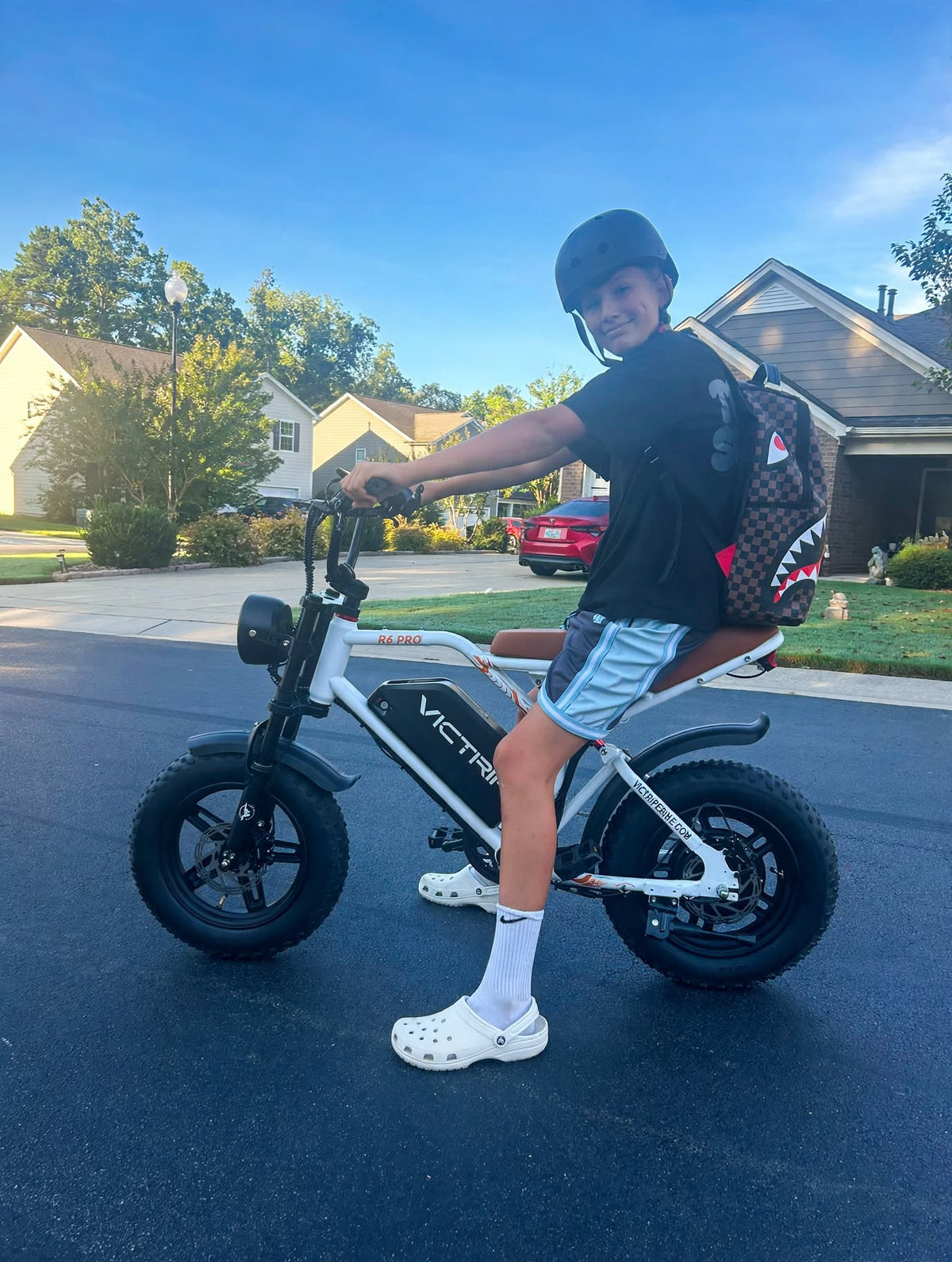
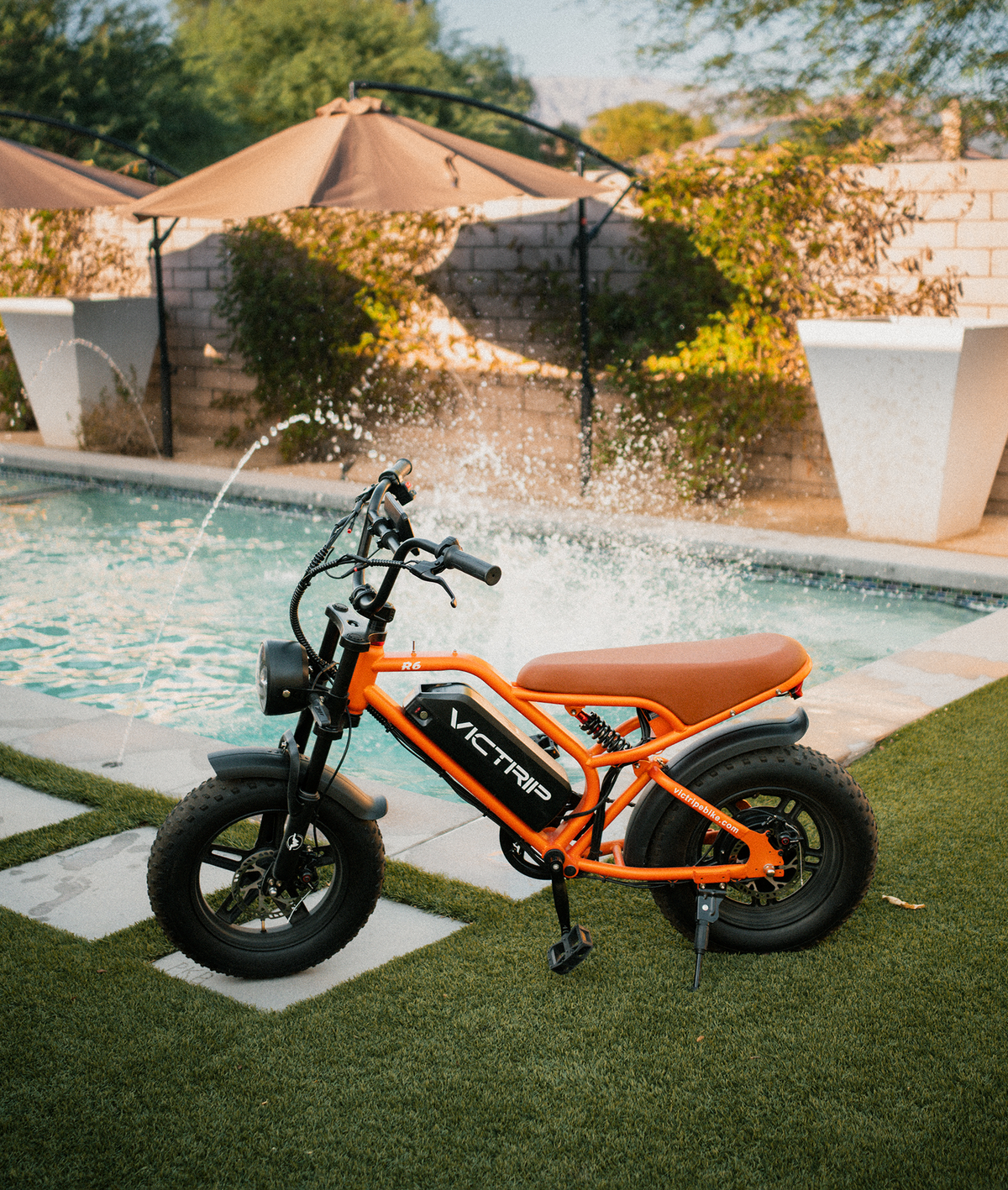
For riders who are ready for a larger platform, theVICTRIP R6 Pro a moped-style electric bike format with full suspension and fat tires. Its larger frame and more substantial build make it better suited to riders who have outgrown smaller youth bikes and need a bike designed around a different riding position and terrain.
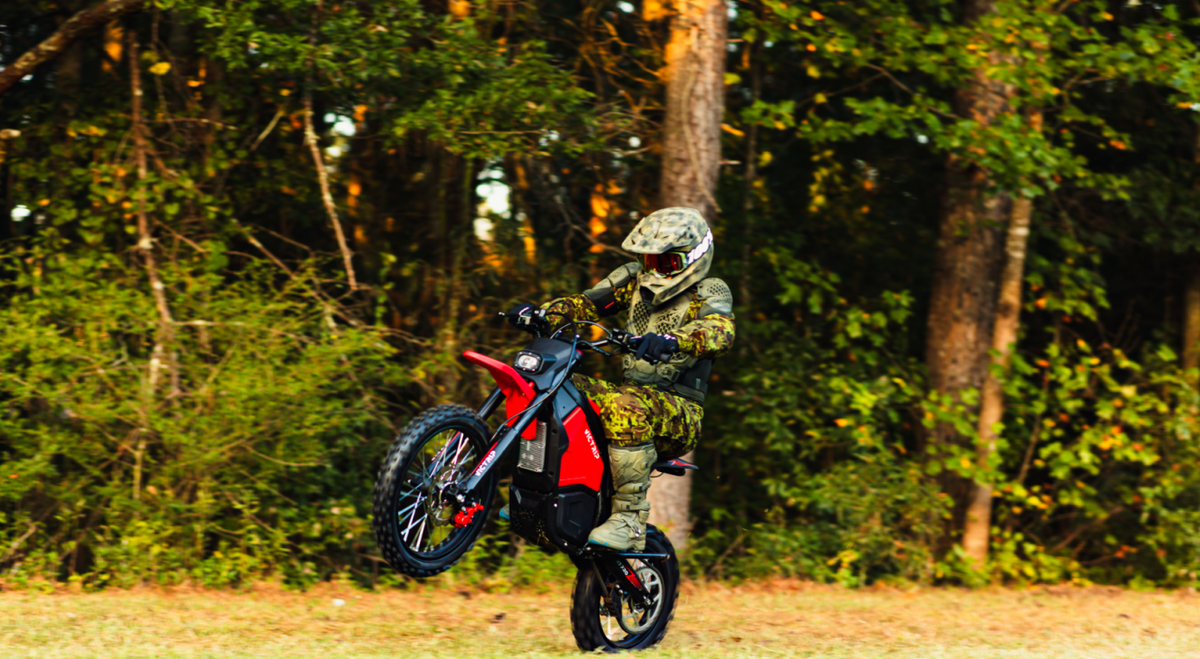
For experienced riders looking for a more performance-oriented off-road platform, the VICTRIP R7 provides a different riding experience. Its dirt-bike-inspired design is intended for off-road use, so parents should pay particular attention to rider maturity, physical control, protective equipment, and where the bike can legally be operated.
Neither model should be selected simply because it has more power. As riders move into larger and faster electric bikes, control, braking ability, riding environment, and legal requirements become increasingly important.
Before choosing either model, review the manufacturer's current specifications, rider recommendations, operating instructions, and local regulations to make sure the bike matches the rider's experience and intended use.
How to Compare Two Youth Electric Bikes
When two models look similar, use a simple comparison process.
Step 1: Compare Rider Fit
Start with:
- Rider height.
- Rider weight.
- Seat position.
- Handlebar reach.
- Overall bike weight.
Step 2: Compare Performance
Look at:
- Maximum speed.
- Motor output.
- Acceleration characteristics.
- Riding modes.
- Throttle or pedal-assist setup.
Step 3: Compare Safety Equipment
Check:
- Brake type.
- Lights.
- Reflectors.
- Bell or horn.
- Tire design.
- Frame construction.
Step 4: Compare Battery Information
Look at:
- Battery capacity.
- Charger specifications.
- Warranty.
- Replacement options.
- Safety certifications or compliance information.
Step 5: Check the Rules
Don't assume that the same e-bike can be ridden legally in every state, city, park, or trail.
PeopleForBikes maintains information about state-level e-bike policies, while local land managers can impose additional rules for specific riding areas.
Common Buying Mistakes Parents Should Avoid
Buying Based Only on Motor Wattage
More power doesn't automatically equal a better beginner experience.
Choosing a Bike That's Too Large
A young rider may grow into a larger bike, but they still need to control it safely today.
Ignoring Weight
A heavy e-bike can be difficult for a smaller rider to move when the motor isn't operating.
Focusing Only on Range
A huge battery may be unnecessary if the bike is primarily used for short neighborhood or recreational rides.
Skipping the Owner's Manual
The manual contains important information about charging, maintenance, operating limits, and safety.
Assuming All "Kids' E-Bikes" Are Equivalent
Some products marketed toward young riders have very different speeds, power levels, dimensions, and legal classifications.
Read the actual specifications.
A Parent's Pre-Purchase Checklist
Before clicking "Buy," ask these questions:
- Does the rider fit the bike now?
- Is the bike's speed appropriate?
- Can the rider comfortably reach the brakes?
- Is acceleration predictable?
- Is the bike's weight manageable?
- Are replacement batteries available?
- Does the manufacturer provide clear charging instructions?
- Are the battery and electrical system appropriately certified or documented?
- Where will the rider use the bike?
- Is that location legally permitted?
- What age restrictions apply?
- What protective equipment is needed?
- Does the rider know basic bicycle safety?
- Does the bike come with a clear owner's manual?
- Is customer support available if something goes wrong?
If several answers are unclear, keep researching before purchasing.
FAQs
What is the best age for a youth electric bike?
There isn't one universal age that works for every rider or every e-bike. Age requirements can depend on the product, state, local laws, and riding environment. Parents should check the manufacturer's age and weight guidance and applicable local regulations before allowing a young rider to use an e-bike.
Are electric bikes safe for beginners?
An electric bike can be used by a beginner when the bike is appropriate for the rider and the rider receives proper instruction. Beginners should start at low speeds in controlled environments and learn braking, steering, and motor controls before riding in more complicated areas.
What size electric bike should a child use?
Bike size should be based primarily on the rider's height, weight, reach, and ability to control the bike. Manufacturer fit recommendations are a useful starting point, but parents should also consider whether the rider can comfortably operate the brakes and maintain balance.
Should a beginner use a throttle e-bike?
It depends on the rider, product, and local rules. A throttle can provide motor assistance without pedaling, so parents should make sure the rider understands how the control works and can release it immediately when necessary.
Do youth electric bikes need helmets?
Parents should treat helmets as essential safety equipment. CPSC recommends wearing a properly fitted bicycle helmet when riding bikes and e-bikes. Local laws may also establish specific helmet requirements based on age or e-bike classification.
Can a child ride a Class 3 e-bike?
Rules vary by jurisdiction, and age restrictions can apply. Parents should check the current laws where the bike will be used rather than assuming that a Class 3 e-bike is permitted for a young rider.
Conclusion: Focus on Fit, Control, and Safety
Choosing among the top youth electric bikes for beginners isn't about finding the bike with the biggest motor or longest range. It's about matching the bike to the rider.
Start with fit. Then consider speed, acceleration, braking, weight, tires, battery safety, and the environment where the bike will be used.
Most importantly, give young riders time to learn.
A successful first experience should involve controlled practice, proper protective equipment, regular bike inspections, and clear family rules about where and how the bike can be ridden.
When parents focus on these fundamentals, an electric bike can become more than a fun gadget. It can be a useful way for young riders to develop confidence, responsibility, and better riding habits while enjoying time outdoors.
Share:
Electric Dirt Bike vs ATV: Which Is Better for Trail Riding?