
Foldable Electric Bikes for Last-Mile Transportation are reshaping how people and goods complete the first and final segments of urban trips. If you’re a commuter tired of transit delays, a small-business owner exploring greener delivery, or a city planner mapping micromobility lanes, this guide is for you. It’s practical, evidence-minded, and optimistic — and it puts the most important choices front and center so you can act quickly.
Why foldable electric bikes excel at last-mile transport
Energy, range and urban fit
Foldable electric bikes (FE-bikes) combine compactness with surprisingly efficient electric propulsion. They typically use lithium batteries sized for short to medium urban hops — think 20–80 km real-world range depending on assist level, rider load, and terrain. Because of that, they're perfectly tuned for last-mile legs that average a few kilometers and often require door-to-door access.
-
They slip on to buses and trains, enabling seamless multimodal trips.
-
They fold into offices or ride trunks, reducing theft risk and parking friction.
-
Their lower top speed (relative to mopeds) often means fewer regulatory hurdles while still being fast enough to beat cars in busy cores.
In short, FE-bikes meet exactly the constraints last-mile trips impose: short distances, variable surfaces, and a premium on portability.
Practical economics & lifecycle
The total cost of ownership for a well-chosen foldable e-bike is attractive. Upfront costs vary by quality and battery capacity, but operating costs are tiny: electricity for a full charge is generally a few cents, and maintenance is lower than that of an internal combustion vehicle. When planned into a fleet, these machines multiply productivity — couriers can finish more deliveries per hour, commuters can skip car fees, and businesses can lower last-mile costs.
Environmental gains
A fleet shift to FE-bikes drastically lowers per-trip emissions, particularly when replacing car or small van legs. Reduced congestion, lower noise, and smaller physical footprint make them urban friendly. Also, battery recycling improvements and swappable battery ecosystems are reducing lifecycle impacts fast.
Design & features that matter
Frame, folding mechanism and portability
Not all folds are equal. Look for:
-
A robust locking hinge with minimal play.
-
Low-center frames for stability when riding folded vs. unfolded.
-
Quick-release latches that can be used with one hand.
-
A compact folded volume (measured in liters or dimensions) rather than weight alone, because storage space often dictates usability more than the scale on a bathroom scale.
Pro tip: test the fold in person — a theoretical folded volume means less than an awkward, heavy package you can’t move quickly.

Battery, motor and charging realities
Batteries determine range and convenience. Demand these characteristics:
-
Nominal capacity (Wh) and realistic range estimates.
-
Removable batteries for swappable or in-office charging.
-
BMS (battery management system) protections for longevity and safety.
-
Charging time — fast charging is great but can shorten battery life; a balance is best.
Motors: hub vs mid-drive. Hub motors are simpler and lower-cost; mid-drives are more efficient on hills and improve balance but add complexity.
Safety, lights, brakes and compliance
Safety features matter more in urban environments:
-
Hydraulic or quality mechanical disc brakes for repeatable stopping power.
-
Integrated lights (front and rear) with daytime running modes.
-
Reflectors and bright paint or reflective tape for visibility at dawn/dusk.
-
Compliance with local e-bike class rules (power and speed limits).
Cargo & accessory options
For last-mile utility, accessory fitment is key: racks, panniers, front boxes, or purpose-built courier mounts. A modular approach — where the bike can accept modular cargo platforms — extends versatility.
Choose the right model and implement last-mile strategy
Use cases: commuters, couriers, shared fleets
-
Commuters: prioritize comfort, lightweight folding, and theft avoidance options.
-
Couriers: focus on payload capacity, quick battery swaps, and robustness.
-
Shared fleets: durability, serviceability, and locking/telematics integration matter most.

Cost breakdown and total cost of ownership
Consider:
-
Purchase price (or lease).
-
Accessories (locks, lights, bags).
-
Battery replacement (every 2–5 years depending on cycles).
-
Maintenance (brakes, tires, drivetrain).
-
Insurance & registration (if required).
A sample three-year TCO for a commuter FE-bike often undercuts city car ownership when parking and fuel are included.
Deployment tips for operators & cities
-
Stage battery swap hubs near high-density delivery nodes.
-
Integrate micromobility parking at transit stops to support multimodal trips.
-
Use geofencing to moderate speeds in sensitive zones.
-
Offer training for courier riders on efficient loading and safe folding.
VICTRIP Titan S — Long Distance Electric Bike
A practical example to illustrate the points above is the VICTRIP Titan S Long Range Electric Bike. It balances a long-range battery with a foldable frame and courier-friendly features. If you want a specific model to evaluate, check the Titan-S product page for specs, battery options, and accessory packages. This spotlight is meant as an illustrative insertion — evaluate local service, warranty, and test-ride options before committing.
TOP PICK
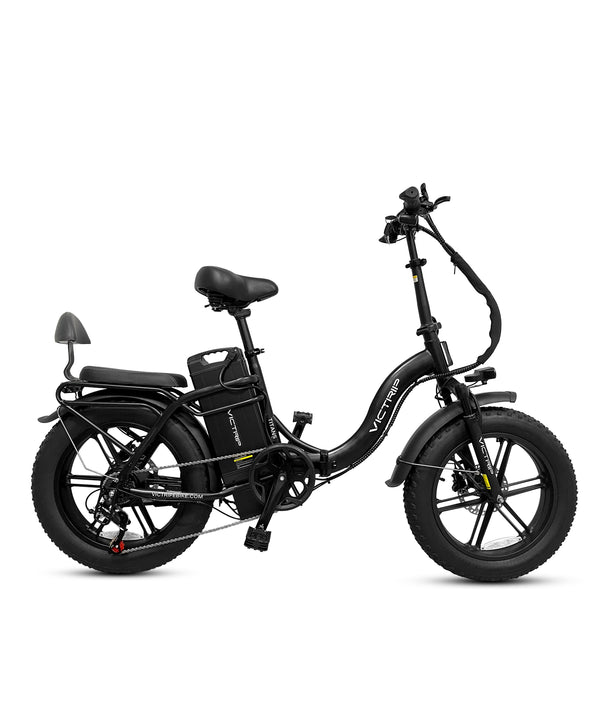
VICTRIP®TITAN S Foldable Long Range Ebike
$1,499.00
Maintenance, lifetime and battery care
Routine checks that save money
-
Inspect folding hinges weekly for looseness and debris.
-
Check tire pressure before the ride — low pressure increases rolling resistance and battery drain.
-
Monitor brake pad wear and replace proactively.
Battery care best practices
-
Avoid full deep discharges when possible; partial charges are friendlier to Li-ion cells.
-
Store batteries in cool, dry places and avoid extreme temperatures.
-
If removable, keep a second battery on rotation for high-use scenarios.
When to replace parts
-
Brake pads: typically every 6–12 months for courier use.
-
Tires: replace when tread or casing is damaged.
-
Battery: capacity drops gradually — plan a replacement at 60–70% original capacity for safety and range guarantees.
Regulations, safety standards and insurance
Know your local class rules
Cities and countries define e-bike classes differently. Many places treat pedal-assist bikes below a threshold (e.g., 250W–750W or a speed cap) differently than throttle-based electric bikes. Ensure your model matches local rules for power, speed, and where it can be ridden.
Insurance & liability for operators
-
Individual riders should consider personal liability and theft insurance.
-
Fleets should insure assets and confirm courier liability coverage.
-
For shared systems, geofencing and speed-limiting software reduce risk and claims.
Comparative table: quick spec check
| Feature | Why it matters | What to look for |
|---|---|---|
| Battery (Wh) | Determines realistic range | 300–800 Wh for flexible range |
| Folded volume | Storage & portability | Compact dims, easy carry handles |
| Motor type | Efficiency vs cost | Mid-drive for hills, hub for simplicity |
| Payload (kg) | Courier capability | 20–60 kg depending on use |
| Charge time | Uptime | 3–6 hrs typical; swappable batteries for fleet |
| Brakes | Safety | Disc (hydraulic preferred) |
| Price | Budget planning | Varies widely; consider TCO |
Conclusion: the pragmatic future of last-mile micromobility
Foldable Electric Bikes for Last-Mile Transportation are an elegant solution to concrete urban problems: congestion, pollution, and the friction of short trips. They’re inexpensive to operate, increasingly durable, and flexible enough for both individual commuters and commercial fleets. While no single model is perfect for every context, the broad category delivers outsized benefits for cities that want to move people and parcels smarter. Start with clear use-case priorities (range, payload, foldability), test a few models in real conditions, and plan for battery lifecycle and maintenance. Do that, and a foldable e-bike will likely pay for itself in saved time, reduced hassle, and a happier commute.
FAQs
Q1 — Are foldable electric bikes legal on bike lanes?
A1 — It depends on local rules and the bike’s class. Many pedal-assist foldables under regional power/speed caps are allowed on bike lanes; always check municipal regs before operation.
Q2 — How far can I really go on a single charge?
A2 — Real-world range depends on rider weight, assist level, terrain, and weather. Expect conservative estimates: 20–80 km; manufacturers’ numbers are often optimistic.
Q3 — Is a mid-drive motor worth the extra cost?
A3 — If you frequently traverse hilly routes or need variable torque, mid-drive motors are more efficient and provide better hill performance. For flat urban cores, a hub motor may be sufficient and less costly.
Q4 — How much do replacement batteries cost?
A4 — Replacement batteries vary from a couple of hundred to several hundred dollars depending on capacity and brand. For fleets, plan for battery replacements every 2–5 years as part of TCO.
Q5 — Can I take a foldable e-bike on public transit?
A5 — Many transit systems permit foldable bikes, especially if compact and stored properly. Check your transit operator’s policy — some require folded bikes only during peak hours.


Share:
Electric Bike Charger Explained: How It Works, Types, and What to Buy
Safety First: Why You Must Buy a UL-Certified Ebike